


Since 2020, significant disaster loss tax relief has existed outside the Internal Revenue Code in a chain of separate statutes, each with its own sunset and set of qualifying dates. Deciding whether a client's situation qualified was complicated.
H.R. 5366, the Doug LaMalfa Federal Disaster Tax Relief Certainty Act, passed the House of Representatives and the Senate and is expected to be signed into law by President Trump. The law codifies and extends these disaster-related tax provisions.
Qualified Disaster Losses - Prior Law
§304(b) of the Taxpayer Certainty and Disaster Tax Relief Act of 2020, as extended by §2 of the Federal Disaster Tax Relief Act of 2024 and §70438 of the One Big Beautiful Bill Act, gave special treatment to qualified disaster losses.
For a qualified disaster loss, the deductible amount is calculated without regard to the 10% of adjusted gross income (AGI) limitation, applies a $500 per casualty floor, and gives non-itemizers the net loss as an addition to the standard deduction.
This special rule applied only to a qualified disaster, which is a major disaster declared between January 1, 2020, and September 2, 2025. Also, this disaster must have an incident period that began on or after December 28, 2019, and on or before July 4, 2025, and must have ended no later than August 3, 2025.
Qualified Disaster Losses - New Law
New §165(h)(6) now refers to it as a qualified net disaster loss and applies the same deduction calculation rules, but simplifies the definition of a qualified disaster area. A disaster is now a qualified disaster area
...if the incident period of the disaster with respect to which such declaration is made begins on or after December 28, 2019, and before January 1, 2027.
The declaration date and the incident period end date are no longer relevant; the only question is when the incident period began.
New §63(b)(8) also changes how a non-itemizer claims the loss. Prior law increased the standard deduction by the qualified disaster loss and required a special rule to preserve it against the alternative minimum tax (AMT), but now the qualified net disaster loss is a separate below-the-line deduction from AGI. Because §56(b)(1)(D) disallows only the standard deduction under §63(c), the deduction now survives for AMT purposes without a special rule.
The new provisions are effective for tax years beginning after December 31, 2024, and supersede prior versions for those tax years, so tax year 2025 is governed entirely by new §165(h)(6) and new §63(b)(8).
Two categories of loss that failed the prior definition now pass it: disasters whose incident period began after July 4, 2025, and disasters whose incident period ran past August 3, 2025. Both are within the new window; once the law is enacted, a taxpayer may, in some cases, consider filing an amended return for tax year 2025.
Qualified Wildfire Relief Payment Exclusion - Prior Law
§3 of the Federal Disaster Tax Relief Act of 2024 excluded qualified wildfire relief payments from gross income, but only for qualified wildfire relief payments received in tax years beginning after December 31, 2019, and before January 1, 2026, as a result of a qualified wildfire disaster.
A qualified wildfire disaster was any federally declared disaster declared after December 31, 2014, as a result of any forest or range fire.
A qualified wildfire relief payment is
…any amount received by or on behalf of an individual as compensation for losses, expenses, or damages (including compensation for additional living expenses, lost wages (other than compensation for lost wages paid by the employer which would have otherwise paid such wages), personal injury, death, or emotional distress) incurred as a result of a qualified wildfire disaster, but only to the extent the losses, expenses, or damages compensated by such payment are not compensated for by insurance or otherwise.
The exclusion does not apply to payments received for losses, expenses, or damages already compensated from another source, such as insurance or §139 qualified disaster relief payments.
Qualified Wildfire Relief Payment Exclusion - New Law
New §139M uses the same rules as above, except that it applies its time limit solely to the disaster declaration date, not to the year of receipt of payment. It now defines a qualified wildfire disaster as any federally declared disaster declared after December 31, 2014, and before January 1, 2027, as a result of any forest or range fire.
For example, a settlement payment received in tax year 2029 with respect to a wildfire declared in 2024 can still be excluded under §139M(a). However, a wildfire disaster declared in 2027 does not qualify for the exclusion.
The new provision is effective for payments received after December 31, 2025.
Example
Below is a recently declared federal major disaster due to fires in Nebraska.
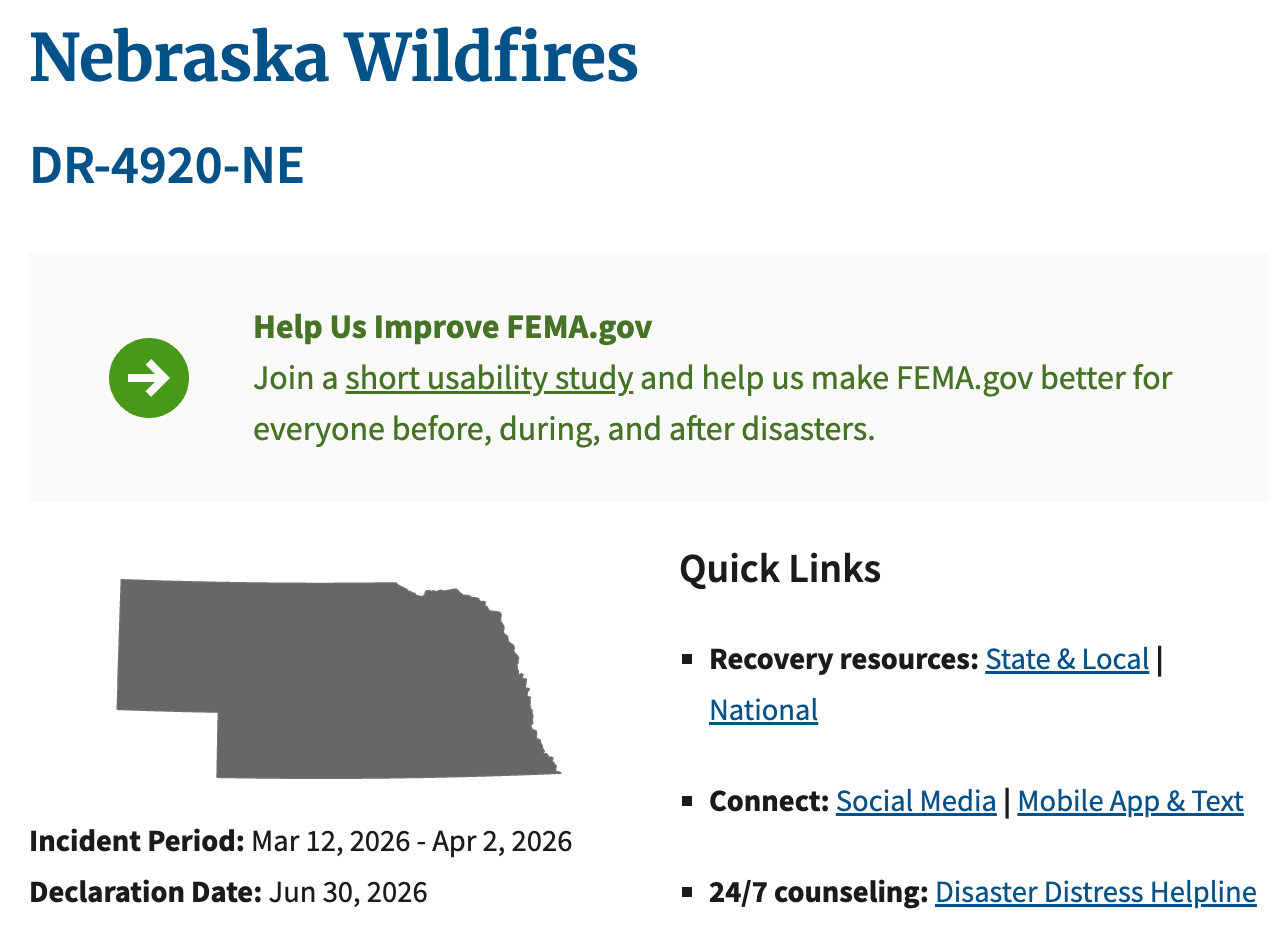
Since the incident period began on March 12, 2026, which is on or after December 28, 2019, and before January 1, 2027, it is a qualified disaster area, and any losses are qualified net disaster losses.
Since it was declared after December 31, 2014, and before January 1, 2027, it is a qualified wildfire disaster, and any qualified wildfire disaster relief payment issued with respect to that disaster, regardless of the year of receipt, is excluded from income.
Join the Conversation
If you are a paid subscriber, you can talk about this topic in the comments section. Please keep the discussion related to this edition’s topic.
So Congress specifically set themselves up for having to amend this law about 6 months from how. If there is some smart logic to that it escapes me. The revenue loss is not particularly predictable anyway so measuring the fiscal impact is pretty vague, so having to limit that seems odd.